Posts

Showing posts with the label alorenzi

Post Modernism and Pluralism 1965-Today : A & A Building by Paul Rudolph

Image
Rudolph Hall , also known as the  Yale Art and Architecture Building  or the  A & A Building , Paul Rudolph, (New Haven, CT); 1959 - 1963; Post Modernism and Pluralism 1965-Today The Yale Art and Architecture Building (the "A&A Building") is one of the earliest and best known examples of Brutalist architecture in the United States. The building still houses Yale University's School of Architecture (it once also housed the School of Art) and is located in New Haven, Connecticut. The Building Designed by architect Paul Rudolph and completed in 1963, the complex building contains over thirty floor levels in its seven stories. The building is made of ribbed, bush-hammered, 'corduroy' concrete. Monumental in its interlocking concrete forms, the building was designed to anchor a key corner site, culminating an architectural procession that includes Yale University Art Gallery, just across the street. The A&A’s massing spins off of four complex...

Frank Lloyd Wright, Louis Sullivan and The Chicago School : Solomon R. Guggenheim Memorial Museum by Frank Lloyd Wright

Image
 Solomon R. Guggenheim Memorial Museum, Frank Lloyd Wright, (New York, New York); 1943 - 1959; Frank Lloyd Wright, Louis Sullivan and The Chicago School Swelling out towards the city of Manhattan, the Solomon R. Guggenheim Museum was the last major project designed and built by Frank Lloyd Wright between 1943 until it opened to the public in 1959, six months after his death, making it one of his longest works in creation along with one of his most popular projects. Completely contrasting the strict Manhattan city grid, the organic curves of the museum are a familiar landmark for tourists and neighbors. The Building Walking inside, a visitor's first intake is a huge atrium, rising 92' in height to an expansive glass dome. Along the sides of this atrium is a continuous ramp uncoiling upwards six stories for more than one-quarter of a mile, allowing for one floor to flow into another. The ramp also creates a procession in which ...

Other Fathers: Charles-Edouard Jeanneret-Gris and Ludwig Mies van der Rohe : S.R. Crown Hall by Ludwig Mies van der Rohe

Image
 S.R. Crown Hall,  Ludwig Mies van der Rohe , (Chicago, Illinois); 1950 - 1956; Other Fathers: Charles-Edouard Jeanneret-Gris and Ludwig Mies van der Rohe Ludwig Mies van der Rohe (or Mies, as he was known) already had a distinguished career before emigrating to the United States in 1937. When he accepted an appointment to head IIT’s College of Architecture (at the time the Armour Institute of Technology) he also agreed to design a master plan for the school’s campus. Mies sought to create a style that reflected the mechanical spirit of the age, and this drive permeated both the curriculum and the buildings he created at IIT. The Building The two-level building is configured as a pure rectangular form, 220 ft. by 120 ft. by 18 ft. tall. The enclosed space is column free with four six ft. steel plate girders welded to eight H-columns. These girders suspend the roof in a single plane to form a primary structure.  While the low...

De Stijil, the Avant-Garde in Modern Europe and the Emergence of the Modern Movement : Café l'Aubette by Theo van Doesburg

Image
 Café l'Aubette, Theo van Doesburg, (Strasbourg, France); 1927; De Stijil, the Avant-Garde in Modern Europe and the Emergence of the Modern Movement Concealed behind an 18th century Baroque façade in Strasbourg’s Place Kléber, the Café L’Aubette is a dazzlingly incongruous expression of the 1920s De Stijl movement.  Designed by Theo van Doesburg, one of the movement’s founders and leading lights, the Aubette’s minimalist, geometric aesthetic was heavily influenced by the work of contemporary artists such as Piet Mondrian. In designing the café’s interiors, Van Doesburg sought to do more than simply place viewers before a painting; he wanted to envelop them in it. Van Doesburg saw in the cafe the opportunity to implement his own theories of Elementarism. Much like Mondrian, he designed in a purely rectilinear, orthogonal manner; the walls were covered in large grids of brightly colored rectangles. However, Van Doesburg did not rigorously bin...

Early 20th Century Pioneers : The Austrian Postal Savings Bank by Otto Wagner

Image
Austrian Postal Savings Bank, Otto Wagner, (Vienna, Austria); 1903 - 1912; Early 20th Century Pioneers Also known as K.K. Postsparkassenamt and Die Österreichische Postsparkasse, the Postal Savings Bank is often cited as architect Otto Wagner's most important work. In its design, Wagner accomplishes beauty with functional simplicity, setting the tone for modernism. British architect and historian Kenneth Frampton has described the exterior this way: "...  the Post Office Savings Bank resembles a gargantuan metal box, an effect due in no small measure to the thin polished sheets of white Sterzing marble that are anchored to its façade with aluminum rivets. Its glazed canopy frame, entrance doors, balustrade and parapet rail are also of aluminum, as are the metal furnishings of the banking hall itself. " — Kenneth Frampton The "modernism" of the architecture is Wagner's use of traditional stone materials (marble) held in place by new buildin...

18th-19th Century Architecture in America: The Fisher Fine Arts Library by Frank Furness

Image
 Fisher Fine Arts Library (Furness Library) of University of Pennsylvania , Frank Furness, (Philadelphia, Pennsylvania); 1888-1890; 18 th -19 th Century Architecture in America Pennsylvania Academy of the Fine Arts , in Philadelphia (PA) is the oldest art academy and museum in the United States, founded 1805. Specializing in American painting and sculpture of the 18th to the 20th century, the Academy’s Art Museum was built between 1872 and 1876 according to designs by architect Frank Furness. The building’s architectural style is high Victorian. For its centennial year (1976), which coincided with the U.S. Bicentennial, the museum underwent a complete renovation. A 12,000-volume library of art history focuses primarily on American painting and sculpture. The Building Located on the campus of the University of Pennsylvania, this historic library, built from red sandstone and brownstone, was designed to...

Early 18th Century Architecture in Europe: École de Chirurgie of Jacques Gondouin

Image
  École de Chirurgie , Jacques Gondouin, (Paris, France); 1769-1774; Early 18 th Century Architecture in Europe The building was designed by the architect Jacques Gondouin from 1769 to 1774 after surgery came to be recognized as a specialized discipline in the medical sciences. The people of the time saw surgery as a progressive movement and wanted to be a part of it, hence why the lectures weren’t only exclusive to the students but the public’s presence was admitted and encouraged as well. The building is currently a part of the Université René Descartes, and is mainly used as a medical and social sciences building. The Building " A monument of the beneficence of the King...which should have the character of magnificence relative to its function ; a school whose fame attracts a great concourse of Pupils from all nations should appear open and easy of access . The absolute necessity of columns to fulfill these two objects , is alone suff...

Industrialization and the City: A new way of living - The Phalange of Charles Fourier

Image
  Phalanstère , Charles Fourier ; 1800s; Industrialization and the City The Architect Charles Fourier (1772-1837), full name François-Marie-Charles Fourier, was a French social theorist who advocated a reconstruction of society based on communities of productive individuals known as phalanges (from the Ancient Greek word phalanx – military unit). He argued that a natural social order exists corresponding to Newton’s ordering of the physical universe and that both concepts evolved in eight ascending periods. At the highest stage and when in harmony, man’s emotions would be freely expressed, and to achieve that stage society should be divided into phalanges. He also emphasized on adapting society to human needs and preached on the wastefulness of the capitalist system, a sentiment shared later on by the socialist Karl Marx. The Phalange as An Ideal “A self-contained community of 500-2,000 individuals working for a shared and mutual benefit” ...

Early 19th Century Architecture in Europe: The Bibliothèque Sainte-Geneviève of Henri Labrouste

Image
The Bibliothèque Sainte-Geneviève, Henri Labrouste, (Paris, France); 1843-1850; Early 19 th Century Architecture in Europe Among the most extraordinary spatial creations in European architecture, Henri Labrouste’s libraries are one of the few that marked a turning point for the era, and have been touchstones for library design ever since. Labrouste sought to create an immersive environment of study and reflection in the midst of the city. The Bibliothèque Sainte-Geneviève was admired as much for its efficient solutions to the issues of nascent library science—including layout, flow of readers and books, and space and light-, but also for its role of knowledge and information in modern society. The Library The Bibliothèque Sainte-Geneviève is the first self-contained public library fitted out within an ornate structure. Its facades are mainly decorated with a seemingly endless list of names, forming a catalog of writers and leaders in all domains of inte...

Neoclassicism and the Enlightenment: The Newgate Prison of George Dance

Image
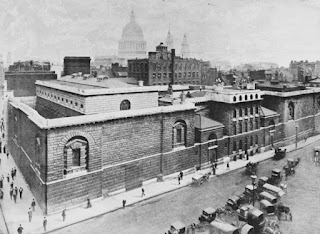
Newgate Prison, George Dance, (London, UK); 1782-1904 ; Neoclassicism and the Enlightenment If in 1982 an observer had taken for a stroll in the London’s streets, and had reached the corner where Newgate Street and Old Bailey meet, one would have instantaneously noticed the austere building that stood and loomed in the desert plaza. Just by looking at its exterior walls any observer would have realized the nature of the building. Though its façade was impressive like a bank, no person would have mistaken the sight of hung chains for a welcome sign. The original prison at Newgate was built in 1188 but was rebuilt in 1770 by George Dance, though the completion date had to be delayed by two years due to being badly damaged during the Gordon Riots in 1780.  The Architect   George Dance, the Younger, (1741-1825), was a British architect who was responsible for extensive urban redevelopment in London and was a founding member of Great Britain’s Royal Academ...