Posts

Showing posts with the label england

Birkenhead Park, (Birkenhead, Merseyside, England); 1847; Greek Revival
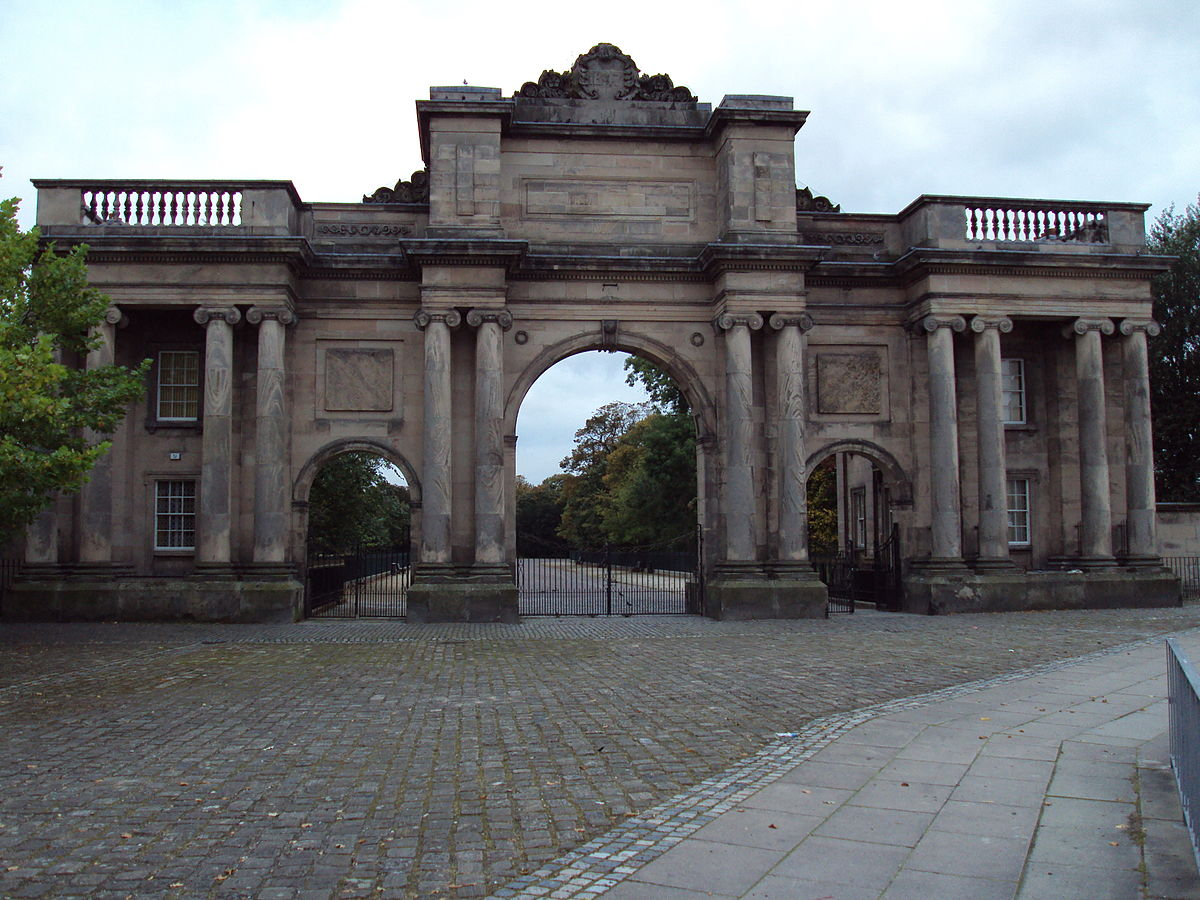
Image
Birkenhead Park is a public park located in Merseyside, England and opened on April 5, 1847. The Birkenhead Park is known as one of the first publicly funded parks in the world. The park came to be when the idea of a municipal park was proposed by the Improvement Commission in 1841. The Improvement Commission is part of Birkenhead’s local government. 226 acres of land from the western edge of Birkenhead was used to create this park. There were certain parts of the land that were proposed to be part of the park but it was later sold so that construction of the park could be afforded. In order to enter the park, there are five different entrances with lodges. The largest entrance is called the Grand Entrance Gateway, which is shown in the picture above. There are three archways, two small and one big. The entrance is also supported by columns which are in groups of two. There are six groups of two columns on the Grand Entrance Gateway. It was designed by Louis Hornblower. The other e...

Palace of Westminster, (London, England); 1016; Gothic Revival

Image
The Palace of Westminster is where the two houses of the Parliament of the United  Kingdom, House of Commons and the House of Lords meet. It is located in the city of Westminster in London, England. More specifically, it is located on the right bank of the River Thames. The palace was built in 1016 but had to be demolished in 1834 because of a fire. It was then rebuilt from 1840 to 1876. The architectural style of the Palace of Westminster is gothic revival. The architect of the palace is named Sir Charles Barry. Barry uses a style of architecture called the Perpendicular Gothic style. It was popular during the 15th century and then it came back in the 19th century during the gothic revival period. Although Barry was not a gothic architect, he had the help from Augustus Pugin. In the 11th century, Barry designed the Westminster Hall and managed to survive the fire in 1834. However, Pugin did not like the symmetrical aspects of the building. The Palace of Westminster has three...

The Iron Bridge,(Ironbridge Gorge, UK); 1775-9; Industrial Revolution

Image
The Iron Bridge is a bridge across the River Severn in Shropshire, England. It is opened in 1781. It was the world's first bridge made of cast iron and to make this material become popular after construction due to the use of new materials in next century.It also showed the great result of Industrial Revolution after 1760.  Even though the time is in the  Industrial Revolution, but it still in the beginning .Construction technique ,mining skill, and smelting skill were not maturity.  The site is close to the ferry between Madeley and Benthall, because it is close to both sides and the ground is relatively strong. The Parliamentary Act describes how to build a bridge near Samuel Barnett from a point of view of the Benthal Parish, near a place on the other side of the Tomask-Rupton house. Masonry and abutments were built between 1777 and 1778. In the summer of 1779 the ribs were lifted into place by the use of wooden jibs and cranes. The bridge first cro...

Syon House, (London, UK); 1547; Renaissance architecture

Image
The exterior of Syon House was built in 1547 and owned by the First Duke of Somerset. Syon's current interior was designed by Robert Adam in 1762 under the commission of the First Duke and Duchess of Northumberland. The house has three parts: The Conservatory, the House, and the Courtyard and Garden. Syon House's final plans include a hallway, an anteroom, a national restaurant, a national painting room, a promenade, a study, a living room, a printing room, a family painting room, a family restaurant, and a private family apartment on the top floor living on a grand staircase. The both sides of gateway has put four columns with sculptures. The middle of the gateway (entrance) is arch with two side gates which are tiny poles with curve. The top of the gateway is a lion. The terms of “Adam style" started from Syon House. It was commissioned to build in a neoclassical style, which was completed, but Adam's style isn’t only like the same. Syon House is filled with dif...

Kensington Palace, (London, England); 1605, Neoclassicism and the Enlightenment - Faheema Ismail

Image
                Originally known as Nottingham House, Kensington Palace is known to have housed English royalty for over four centuries. Back in 1689, this now glorious palace stood to be a mere two stories tall and was quite modest in comparison to the structure as it stands today. It started as a small mansion chosen by new monarchs, William III and Mary II, to be their new country retreat, but over the years the estate was transformed into a home worth housing Britain’s royal families. In 1837, Kensington hall was replaced by Buckingham Palace and has since become a home for minor royals. Some of the most recent occupants are the Princess of Wales, Diana, The Duke and Duchess of Cambridge and their kids, and Prince Harry.                 In 1689, the King and Queen commissioned plans from Sir Christopher Wren, to scale this little ...

Kew Gardens, (London, England) 1772-present, NeoClassicism

Image
The Kew Gardens were originally known as the Royal Botanical Gardens located in Kew, London. Since as early as the 16th century, the Kew Gardens were maintained and tended privately. In 1731, the Kew Gardens were acquired by the prince and princess of Wales. Kew Gardens gained its recognition when it was under the management of Sir Joseph Banks (1772-1819) and eventually the gardens contained all different types of plant species from various places of the world. In 1865, when Sir William Jackson Hooker took management of the gardens, it became a center for scientific research. One of the main purposes of English greenhouses was to display the range of exotic plants that flourished in the British Empire. Kew Gardens encompasses 121 hectares of gardens and botanical glasshouses from Kew to Richmond in London. The Kew site includes four Grade 1 listed buildings and 36 Grade 2 listed buildings on a dynamic landscape. In England, Grade 1 listed buildings are buildings of exceptional i...

Thomas More UTOPIA

Image
An imaginary island described in sir Thomas mores utopia (1516) as enjoying perfection in law, politics, etc. He essentially didn’t believe in change, he wanted to create an ideal place with no government control. The majority of the population would be in the city, which is the center followed by its surrounding countryside. It is based off a rectangular based plan similar to the roman urban planning. sir More knew what poor living conditions was like with no sunlight, bad hygiene and narrow streets. He was very generous when he was designing the ideal city. It had a lot of space, so much that you cannot walk to your closest neighbor’s house. It was 54 cities in total with no more than 6000 families per city. It is a place where there is a barrier between what is playful or serious, function and reality. It stretches utopia from all sides and also creates a thin line between the thought of experience and  dwells to live on. Thus utopia was more less a fantasy land whi...

Bank Of England

Image
Bank Of England      Established in 1694 the Bank of England, it is the second oldest central bank in operation today. The Bank of England is the world's 8th oldest bank. It was established to act as the English Government's banker and is still one of the bankers for the Government of the United Kingdom.In 1998, it became an independent public organization, wholly owned by the Treasury Solicitor. England's crushing defeat by France, the dominant naval power, in naval engagements culminating in the 1690 Battle of Beachy Head became the catalyst for England's rebuilding itself as a global power. The Bank's original home was in Walbrook, a street in the City of London, where during reconstruction in 1954 archaeologists found the remains of a Roman temple of Mithras. Sir Herbert Baker's rebuilding of the Bank, demolishing most of Sir John Soane's earlier building, was described by architectural historian Nikolaus Pevsner as "The greatest architectu...

The Penguin Pool, (London, England)

Image
The Penguin Pool The Penguin Zoo designed by Berthold Lubetkin and the Tecton Group is located in the London Zoo at Regents Park  in London, England. The project begun in 1933 and finished in 1934. This architectural structure is an important piece of the British modernist architecture movement. The penguin pool was one of the first structures to begin to explore and demonstrate the structural potential of reinforced concrete and how it can become expressive. The project consisted of a stretched elliptical pool, a deep diving tank enclosed by glass, and nesting areas around the perimeter. This design was based on a concept of behaviourism. This concept was a popular philosophy of psychology in the 1930s as it claimed that the behavior of animals is a result of their external environments. To incorporate this into the design process, Berthold Lubetkin and the Tecton Group wanted to mimic the natural habitat of the penguins to provide an acceptable environment while creating a s...

The Elephant and Rhino Pavilion- 18th and 19th Century Architecture in America - Emilia Kightley-Sutter

Image
ELEPHANT AND RHINOCEROS PAVILION LONDON ZOO, REGENTS PARK In the London Borough of Westminster, the Greater London Authority county there is an animal hour, designed in 1961 by Sir Hugh Casson, Neville Conder and Peter Shepherd which houses elephants and rhinoceros. It is made from reinforced concrete, surrounded by textured walls to prevent the animals actually rubbing against them, and injuring themselves or the structure. The copper roofs give an industrial feel and contrast the rubbed texture on the walls.  The walls are so thick they can withstand the force of an elephant “head-butt.” The zoo alike many zoos gives a sense of fake naturalism, with its looped moat and varying sized elliptical cavities. Mappin Terraces create the illusion of elephants or rhinoceros clumping their heads together, it is unknown if that was Casson’s intention or not. This design feature shows the buildings function through its design and gives audience members a sneak peek of what is to come ins...