Posts

Showing posts with the label greek revival

Fairmount Water Works, (Philidelphia, Pennsylvania), 1812-1872, Greek Revival

Image
     The Fairmount Water Works in Philadelphia, PA was the second waterworks in the state and was designed by Frederick Graff in 1812. The project which consists of six seemingly separate structures, was continuously built between 1812-1872 and operated until 1909. In the late 18th century many outbreaks of yellow fever pushed the government to assemble a “Watering Committee”. A new water system was put into place in 1799 which consisted of two steam engines that pumped water through main pipes and into the city. The systems main problem was that if one engine stopped running the entire system would shut down. A new design which contained 3 million gallons of water held in a reservoir atop Faire Mount was constructed. There was initially one pump house which held two steam engines that pumped water into the reservoir. A new technology was discovered an In 1819 the 1,600 ft dam which is adjacent to the project was constructed. Acting as a spillway, the dam rout...
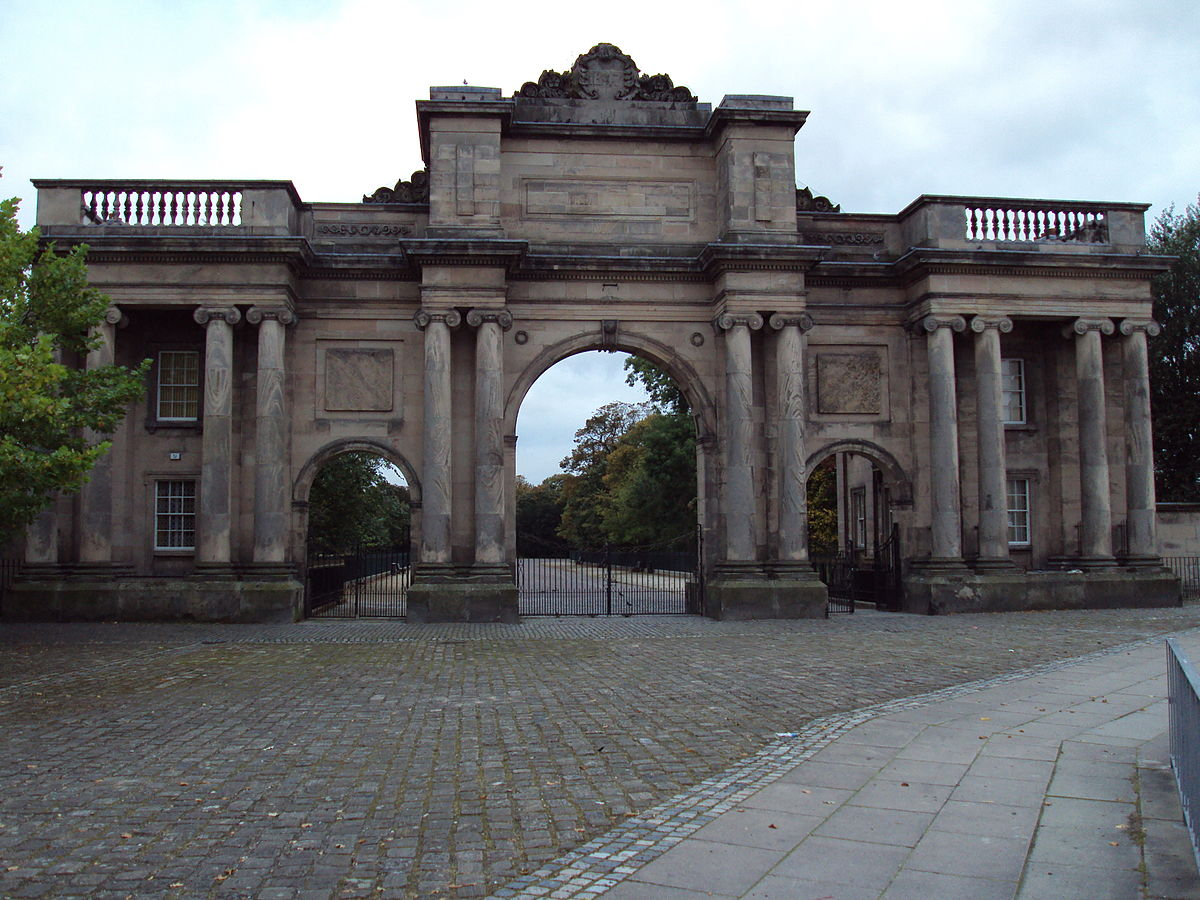
Birkenhead Park, (Birkenhead, Merseyside, England); 1847; Greek Revival

Image
Birkenhead Park is a public park located in Merseyside, England and opened on April 5, 1847. The Birkenhead Park is known as one of the first publicly funded parks in the world. The park came to be when the idea of a municipal park was proposed by the Improvement Commission in 1841. The Improvement Commission is part of Birkenhead’s local government. 226 acres of land from the western edge of Birkenhead was used to create this park. There were certain parts of the land that were proposed to be part of the park but it was later sold so that construction of the park could be afforded. In order to enter the park, there are five different entrances with lodges. The largest entrance is called the Grand Entrance Gateway, which is shown in the picture above. There are three archways, two small and one big. The entrance is also supported by columns which are in groups of two. There are six groups of two columns on the Grand Entrance Gateway. It was designed by Louis Hornblower. The other e...

GREEK REVIVAL STYLE

Image
ANDALUSIA, PA This is an architectural style that mimics or is a copy of Greek motifs that is done by a lot of architects. Greek style usually consists of column and pilasters, round columns are commonly used but square or even octagon columns have also been used. The main reasons for the style’s popularity seem to have been the general intellectual preoccupation with ancient Greek culture at the time, as well as a new awareness of the actual nature of Greek art brought about through widely circulated illustrations of notable ancient temples and the Elgin Marbles. The door itself might be single whether or double, is then divided into one, two, or four panels. Almost invariably, a portico or porch was added in front of the entrance. Architects were coming up with interesting variations of Greek styles for about two decades of the mid-19th century. Whether it’s a townhouse or freestanding it comes in various materials. For example, in Brooklyn, they are materials like brick, brow...

Dresden Opera House, (Dresden, Germany); 1841; Early 19th Century Architecture in Europe

Arch 162-M12 Spring 2018 “The Opera House”              The Opera House located Dresden, Germany. Designed by Gottfried Semper in 1841. Later the son Manfred Semper reconstructed the opera house in 1869 after the fire. A decade later it was destroyed by a bombing in 1945.   After the reconstruction, the theater had the painting restored by local craftsman and the rest of the auditorium was replaced with state of the art stage equipment. The façade mostly decorated with Doric and Ionic columns. The Doric columns have a masculine look to them. The Ionic columns have a feminine crenulation. Both of these combined have an interesting aesthetic look which give a unique look to the Dresden Opera House. Which has a strong resemblance in the Greek Revival and Baroque styles. It also includes statues to great artist as Shakespeare and Moliere. It is regarded as one of the best acoustically sound opera houses in the world. The rea...